
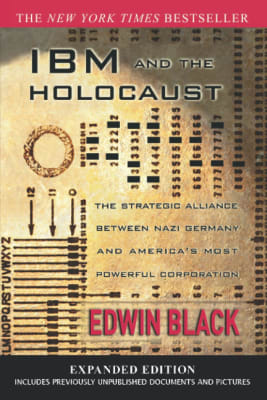
IBM and the Holocaust
The Strategic Alliance Between Nazi Germany and America's Most Powerful CorporationReview
IBM and the Holocaust: The Strategic Alliance Between Nazi Germany and America's Most Powerful Corporation by Edwin Black is a meticulously researched, shocking exposé that reveals the disturbing complicity of an American corporate giant in one of history's greatest atrocities. Black's expanded edition builds upon his already damning investigation, adding more documentation and evidence to support his thesis that IBM's technology was not merely incidentally used by the Nazis, but was actively and strategically provided to facilitate the Holocaust.
The most chilling aspect of Black's account is his detailed documentation of how IBM's Hollerith machines and punch card technology became the backbone of Nazi bureaucratic efficiency in identifying, cataloguing, and ultimately exterminating European Jewry. Nowhere is this more profoundly illustrated than in the case of the Netherlands, where Black demonstrates with terrifying clarity how the meticulous nature of Dutch record-keeping—when combined with IBM's data processing capabilities—created a perfect storm for the near-total destruction of Dutch Jewry.
In the Netherlands, the Nazis leveraged existing census data that the Dutch government had already collected, transforming this routine bureaucratic information into a weapon of persecution. As Black meticulously documents, IBM's German subsidiary Dehomag provided the Hollerith machines that could process this vast amount of data with unprecedented speed and accuracy. The machines cross-referenced religious affiliation, ancestry, residence, and occupation to create comprehensive profiles of virtually every Jewish person in the Netherlands. What had once been scattered records became a unified, searchable database of potential victims.
What makes Black's account so harrowing is the specific detail with which he shows how this data collection directly translated into roundups and deportations. When Nazi officials needed to identify all Jews in a particular Amsterdam neighbourhood, the Hollerith machines could rapidly generate lists complete with addresses. When they wanted to find children who had been hidden with non-Jewish families, the census data helped identify those with Jewish ancestry. The technology essentially removed any possibility of anonymity for Jewish people in the Netherlands.
Black's research reveals that IBM was not a passive bystander but an active collaborator. He documents how IBM's New York headquarters maintained control over its German subsidiary throughout the war, ensuring that the profits flowed back to America even as the machines were facilitating genocide. IBM engineers custom-designed systems for Nazi census-taking, developed specialised punch card layouts for racial categorisation, and provided ongoing technical support as the Nazis refined their methods of persecution.
The book raises profoundly uncomfortable questions about corporate responsibility and the ethical limits of technology. Black argues convincingly that IBM's executives were fully aware of how their machines were being used, yet continued to pursue this lucrative business relationship. The Holocaust was not an inevitable tragedy but required the collaboration of many—including seemingly neutral technological systems that gave evil its bureaucratic efficiency.
IBM and the Holocaust is a disturbing yet essential read that forces us to confront how technology and corporate complicity can facilitate unimaginable atrocities. Black's meticulous documentation—particularly his examination of the Dutch case—provides a chilling reminder that the tools of modernity can be twisted to serve the most barbaric purposes, and that the line between business and evil is sometimes perilously thin. This is not just historical analysis but a warning for our data-driven age, where information has once again become a tool of power that can be used for liberation or oppression.
No comments yet